CURRICULUM & APPROACH
CURRICULUM STANDARDS
Flourish Academy aligns instruction with the Tennessee State Academic Standards to ensure students develop strong foundational skills in Math, Language Arts, Science, and Social Studies. While guided by state standards, our curriculum is thoughtfully adapted to meet the unique needs of homeschool families and individual learners. Teachers integrate multiple standards into meaningful, interdisciplinary units, allowing students to build knowledge through real-world connections rather than isolated worksheets or rote instruction.
Flourish Academy uses a balanced instructional approach that combines structured academic teaching with hands-on, child-centered learning experiences. Math and Language Arts are taught through explicit, grade-level instruction, small-group lessons, and individualized support, while Science and Social Studies are taught using a family-style approach, where students across all grade levels explore the same topic together. Instruction is intentionally differentiated, allowing older students to engage more deeply with the content while younger students build foundational understanding. Teachers differentiate instruction based on each child’s developmental level, learning style, and interests.
Project-based learning, collaborative activities, and thematic units allow students to explore concepts deeply, apply critical thinking, and engage in creative problem-solving. Multi-age collaboration encourages peer learning, leadership, and social development in a supportive community setting.
TEACHING METHODS
Curriculum Materials
Flourish Academy uses a carefully selected blend of research-based curriculum materials and instructional resources to support foundational skill development, project-based learning, and whole-child growth. Curriculum selections are chosen to align with Tennessee State Academic Standards while remaining flexible to meet the needs of homeschool families and individual learners.
All curriculum materials are purchased using the annual supply fee and will be ordered and prepared in advance so that families receive their full set of instructional resources before the start of the school year, ensuring that students and parents have everything they need to begin learning on day one.
Language Arts (Reading, Writing, & Phonics)
We have thoughtfully selected curriculum based on the developmental stages of reading.
For Kindergarten through 2nd grade, students are in the stage of learning to read. During these years, our focus is on building a strong foundation in phonics, spelling, and language skills. We use structured, research-based curriculum that explicitly teaches how the English language works so that students develop confident and capable reading skills.
By 3rd through 5th grade, students transition into the stage of reading to learn. At this level, instruction shifts toward deeper comprehension, vocabulary development, writing, and engaging with rich literature. Students begin using their reading skills as a tool to explore new ideas, analyze texts, and communicate their thoughts through structured writing.
This progression allows students to first master the mechanics of reading and language, and then apply those skills to think critically, write clearly, and grow as lifelong learners.
Learning to Read (K-2)
Reading: Logic of English Foundations
This curriculum provides a strong, research-based foundation for learning to read. The program is based on the Orton-Gillingham approach, a well-established method of literacy instruction that uses explicit, systematic, and multisensory teaching to help students understand how the English language works. It teaches phonics, spelling, and language concepts in a clear and structured sequence while engaging students through hands-on, interactive activities. This approach helps young learners build confidence as they develop essential reading and spelling skills. By focusing on the building blocks of literacy during the early years, students gain the tools they need to become fluent, capable readers who are well prepared for the transition from learning to read to reading to learn in the upper grades.
Writing: Writing with Ease
This curriculum provides a gentle, developmentally appropriate introduction to writing. In the early elementary years, the focus is on building strong language and thinking skills before expecting students to produce longer written work. It uses narration, copywork, and dictation to help students learn how to organize their thoughts, retell information clearly, and develop strong sentence structure. These foundational skills help students grow in both comprehension and written expression while avoiding unnecessary frustration during the early stages of writing development. By building confidence and strong language habits early, students are well prepared to transition into more structured and advanced writing instruction in the upper grades.
Literature/Reading Comprehension: Read Alouds and Novel Studies
Students will be introduced to literature primarily through engaging read alouds and guided discussions. Listening to rich stories allows students to experience vocabulary, story structure, and ideas that may be beyond what they can yet read independently. Teachers will guide students through conversations about the stories, helping them practice skills such as retelling events, identifying characters and settings, and thinking about the lessons or themes within a text. These discussions strengthen comprehension while also building a love for reading. As students grow in confidence and reading ability, they will also participate in simple novel studies and shared reading experiences that help them begin interacting more deeply with literature. This approach allows young learners to develop strong comprehension skills while enjoying meaningful stories together as a class.
Handwriting: Handwriting Without Tears
This curriculum provides a clear, developmentally appropriate approach to teaching handwriting skills. The program uses step-by-step instruction and multisensory activities to help students learn proper letter formation, spacing, and pencil control in a way that is engaging and manageable for young learners. It is designed to build fine motor skills and confidence while reducing frustration often associated with learning to write. Its structured progression allows students to gradually develop neat, legible handwriting as they grow. By establishing strong handwriting habits in the early years, students are better prepared to focus on expressing their ideas through writing as they move into more advanced academic work.
Reading to Learn (3-5)
Spelling: All About Spelling
We chose All About Spelling because it helps students truly understand why words are spelled the way they are—not simply memorize weekly lists. This multisensory, mastery-based program is Orton-Gillingham based, just like Logic of English Foundations, making it a natural next step for students after our K–2 program. Students continue building strong foundations in phonics, spelling, reading, and writing through hands-on, intentional instruction. We chose All About Spelling because it aligns with our belief in engaging, research-based learning that builds lasting confidence and mastery.
Grammar and Writing: Essentials in Writing
We chose Essentials in Writing for grammar and writing instruction because it provides clear, structured lessons that help students become confident communicators. This curriculum breaks writing and grammar skills into manageable steps, allowing students to build strong foundations while developing their ability to express ideas clearly and creatively. Through direct instruction, guided practice, and meaningful writing activities, students grow in both technical skill and confidence. One feature we especially value is that video instruction is available for families to use during at-home learning days, providing additional support and consistency as parents guide their students at home. We chose Essentials in Writing because it aligns with our goal of providing intentional, approachable instruction that supports a wide range of learners while encouraging steady growth in written communication.
Literature/Reading Comprehension: Read Aloud/ Novel Studies
We will continue to use read-alouds and novel studies to deepen students’ understanding of literature and strengthen their comprehension skills. Listening to and discussing engaging stories allows students to explore vocabulary, plot, character development, and themes that support critical thinking and analysis. Through guided discussions, written responses, and structured activities, students learn to make connections between texts and their own experiences, identify key ideas, and analyze how authors convey meaning. Novel studies provide opportunities for students to interact more independently with texts while practicing summarizing, interpreting, and evaluating content. Parents will receive a list of the novels students will be reading before each unit begins, giving families the opportunity to review the content and support their child’s learning at home. This approach helps students transition from reading for basic understanding to reading to learn, equipping them with the skills to think critically, engage with complex texts, and articulate their ideas effectively.
Handwriting: Handwriting Without Tears
For older students, this curriculum will focus on helping students learn and develop confidence in cursive writing. As students grow in their writing abilities, cursive provides a smooth and efficient way for them to record their ideas and complete longer written assignments. The program introduces cursive in a clear, step-by-step way that helps students understand proper letter formation and connections between letters. This structured approach allows students to build fluency and confidence as they transition from print to cursive writing. By learning cursive during the upper elementary years, students gain an additional tool for written communication while strengthening their handwriting skills and overall writing development.
Mathematics
Saxon Math
We have chosen Saxon Math as our core math curriculum. Saxon Math is a well-established program that focuses on building strong foundational skills through a clear, structured approach. Lessons introduce new concepts in small, manageable steps while continually reviewing previously learned skills. This method helps students retain what they learn and develop confidence as they progress.
One of the reasons we selected Saxon Math is its emphasis on mastery through consistent practice and review. Rather than learning a concept once and moving on, students revisit important skills regularly. This steady reinforcement helps ensure that foundational math skills remain strong as students move into more advanced topics.
Saxon Math also aligns well with the learning environment at Flourish Academy. With our small group settings, teachers are able to guide students through new concepts, provide individualized support, and help students build problem-solving skills. This allows us to combine the structure of Saxon with hands-on activities, discussions, and real-world applications that help bring math concepts to life.
Students will work with Saxon Math both during their time at Flourish Academy and at home. This shared approach creates continuity between the classroom and home learning, allowing parents to easily follow along and support their child’s progress.
By using Saxon Math, our goal is to help students develop confidence, consistency, and a strong mathematical foundation that will support them throughout their education.
Science
Unit Studies
Science will be taught through a thematic, multi-age model designed to spark curiosity, encourage exploration, and build deep understanding over time.
Rather than relying on a traditional textbook curriculum, our science program will be built around engaging unit studies that explore major scientific themes such as ecosystems, weather, the human body, energy, and Earth and space. Each unit will be experienced together as a learning community, allowing students across grade levels to engage in shared discovery and discussion.
During whole-group instruction, students will be introduced to key concepts through hands-on experiments, demonstrations, quality literature, and guided discussion. This collaborative setting will foster curiosity and allow students to learn from one another while building a strong foundation in scientific thinking.
Following this shared learning time, instruction will be intentionally layered to support each student’s level of development:
Younger students will focus on observation, exploration, and foundational concepts through hands-on activities, drawing, and simple recording.
Upper elementary students will engage more deeply by collecting and analyzing data, writing explanations, conducting experiments, and making connections between scientific ideas.
This structure will allow all students to study the same topic while developing skills and understanding appropriate to their level.
Example Unit Study: Ecosystems
During an ecosystems unit, all students will explore the same central question: How do living things interact with each other and their environment?
Kindergarten–1st Grade: Students will learn to identify living and nonliving things, explore basic needs of plants and animals, and observe simple relationships in nature. They may draw habitats, sort organisms, and participate in guided outdoor observations.
2nd–3rd Grade: Students will build on this foundation by studying food chains, habitats, and interdependence. They will begin recording observations, creating simple diagrams, and explaining how living things depend on one another for survival.
4th–5th Grade: Students will dive deeper into ecosystem dynamics by analyzing food webs, energy flow, and environmental changes. They may conduct experiments, research real-world ecosystems, and explain how changes in one part of a system affect the whole.
Through this shared topic, all students will gain understanding while older students will develop increasingly advanced scientific thinking and communication skills.
Students will be encouraged to ask questions, investigate ideas, and think critically about the world around them. By revisiting key concepts over time and increasing depth each year, students will build both confidence and competence in science.
Science at Flourish Academy will be presented in a neutral, age-appropriate way, focusing on observable processes and scientific principles while allowing families the flexibility to approach deeper worldview discussions at home.
Parents will receive a full scope and sequence of all unit studies for the school year prior to the beginning of classes, providing clear insight into the topics and skills their children will explore.
Social Studies / History
Unit Studies
Social studies will be taught through a thematic, family-style approach that brings students together around shared topics while allowing each child to grow at their own level.
Rather than relying on a single textbook or traditional curriculum, we will use unit studies built around meaningful themes such as community, geography, history, civics, and culture. Each year, the entire tutorial will explore the same overarching topics, creating a collaborative and engaging learning environment where students learn from both their teachers and one another.
Our social studies program will follow a four-year rotation, ensuring students experience a well-rounded education that includes:
Community and geography
Ancient civilizations and world history
United States history and foundations
Civics, economics, and the modern world
Within each unit, instruction will be intentionally designed to meet a range of ages and abilities. Younger students will build foundational understanding through stories, discussion, and hands-on activities, while older students will deepen their learning through research, writing, critical thinking, and analysis.
What This Looks Like in Practice
For example, during a unit on Community & Geography, all students will explore the same core ideas—how communities function and how location shapes the way people live—while engaging at developmentally appropriate levels:
Kindergarten–1st Grade:
Students will learn through stories, play, and hands-on activities. They will explore what a community is, identify community helpers, and begin learning basic map skills such as directions and symbols. Students may create simple maps of their classroom or neighborhood.2nd–3rd Grade:
Students will begin making connections between geography and daily life. They will study different types of communities, explore landforms and regions, and learn how maps represent real places. Students may compare their community to another and create more detailed maps using keys and labels.4th–5th Grade:
Students will dive deeper into how geography influences culture, economy, and development. They may analyze how location impacts jobs and resources, study local and state geography, and complete research or project-based work such as designing a model community or creating a travel-style presentation.
Throughout the unit, students will participate in shared discussions, collaborative projects, and hands-on experiences, allowing younger students to learn from older peers while older students reinforce their understanding through leadership and deeper inquiry.
Parents will receive the full scope and sequence for all unit studies at the same time curriculum materials are distributed, just prior to the beginning of the school year. This provides families with a clear understanding of what will be covered and allows them to meaningfully support and extend learning at home.
Project-Based Learning Themes
Rather than using a single, set curriculum for projects, students explore a new thematic unit approximately every two weeks. Each theme serves as a foundation for integrated learning experiences across subjects such as science, social studies, reading, writing, math, and creative arts. Projects, hands-on activities, discussions, and collaborative work are designed to align with the theme and encourage curiosity, creativity, and deeper understanding.
Examples of project-based learning themes may include, but are not limited to:
Farms and agriculture
Weather and seasons
Space and astronomy
Community and helpers
Plants and animals
Transportation
Earth and the environment
Cultural celebrations and traditions
Themes are selected based on student interests, developmental appropriateness, and educational standards, allowing learning to feel meaningful, engaging, and connected to real-world experiences. This flexible structure allows teachers to tailor projects to the needs and interests of each group of learners while maintaining strong academic goals.
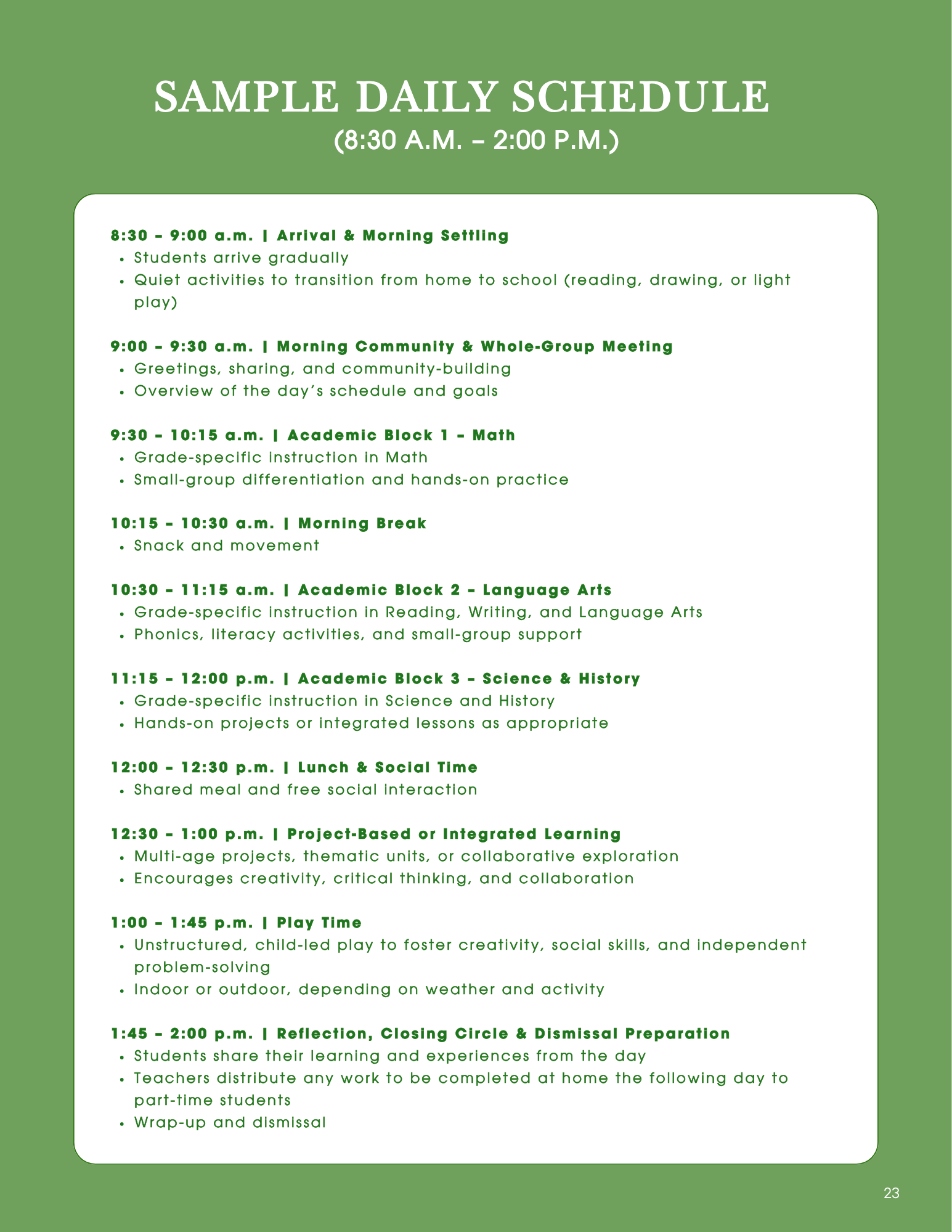
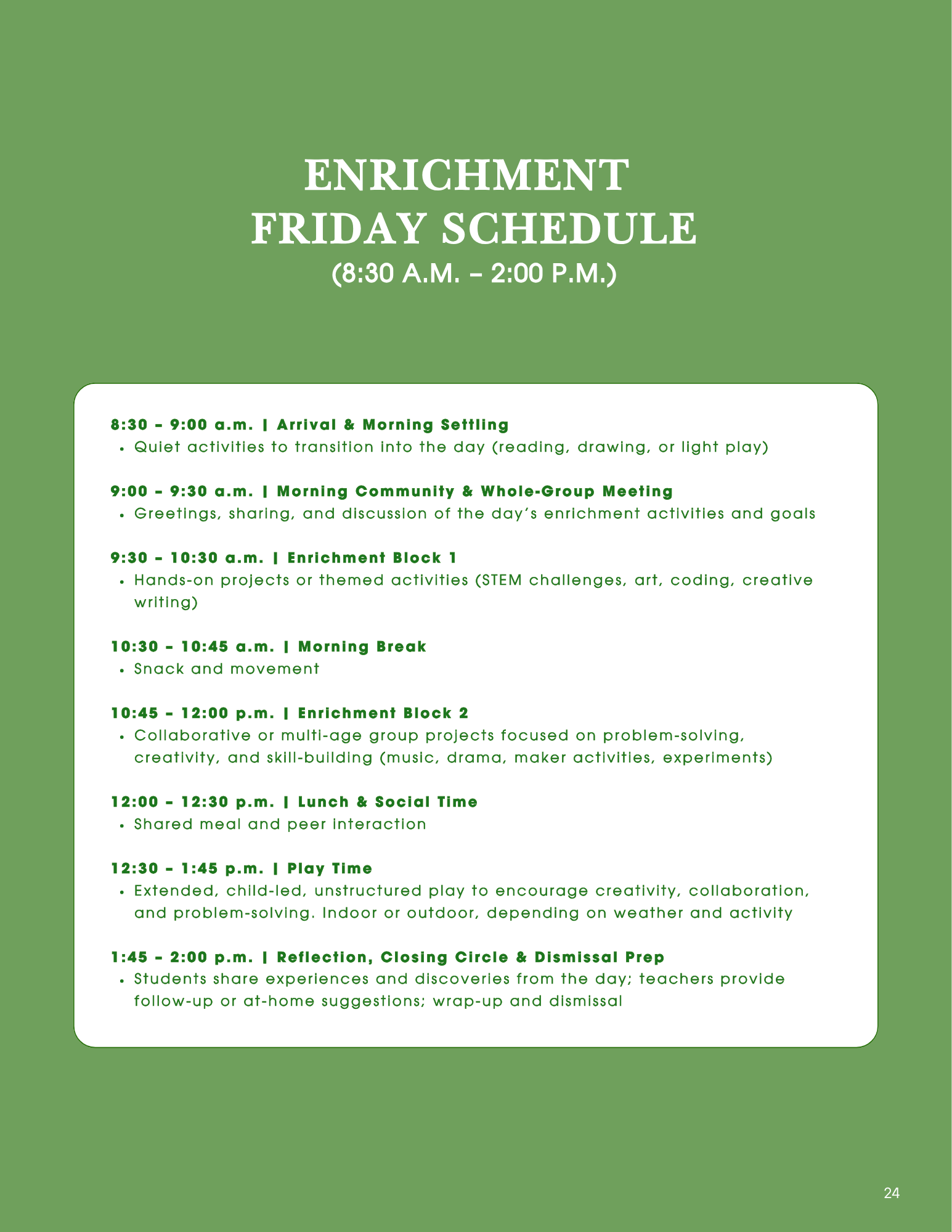
Sample Schedules